Objective:
-Observe how your vocal chords affect the sounds you make
-Observe how your lips, tongue, and teeth influence the sounds you make.
Procedure:
- Pronounce the words in the list below to your partner. Pay attention to how you pronounce the first letter of each word.
- Together decide if you are stopped your breath when you are pronouncing the first letter of each word. Use a check mark to record the the Data and Observations section if the consonant is stopped or open.
Word list:- Boat
- Fan
- Kite
- pen
- sister
- Dog
- Vote- Gate
- Zebra
- Tone
Data and Observations:
First Letter
Stopped
Open
B
Yes
F
Yes
K
Yes
P
Yes
S
Yes
D
Yes
V
Yes
G
Yes
Z
Yes
T
Yes
Conclusion:
Is the shape of your mouth or the position of your teeth or tongue different when you pronounce a "d" than when you pronounce a "t." It is the same sound and position of your mouth
What is the difference between the sound of a "d" and the sound of a "v." D = tongue and lips --> V = Teeth bottom lip.
For which first letter sounds in the table do you use your lips and your boice, but not your tongue or your teeth? B, P
What part of the larynx is like the strings of a guitar? Your voice box.
Going Further:
Why are women's voices urualy of a higher pitch than men's: Men have a larger voice box than woman do.
Why, then, are the voices of young girls and boys of about the same pitch? Boy voice boxes don't develop until later on.
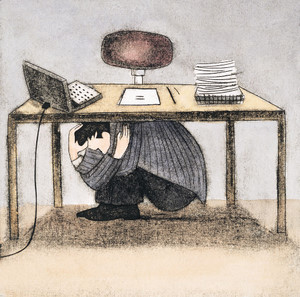
After drawing a sketch up of the downstairs area of my house i realized how dangerous the area is! All together the downstairs of my house has; 9 windows, 3 unsecured tables, 3 unsecured couches, 6 glass doors, 15 unsecured pictures, 6 unsecured book shelves, and a fridge that rolls easily on wheels! As you can see my house would definitely not be the best place to be in an earthquake. There's not much you can do about the windows and glass doors (unless you changed the type of door and got rid of all the windows.) You could secure the tables and couches. However i think that we would need steadier tables due the fact that they are pretty old so they wouldn't hold that much weight if something fell on it so i wouldn't classify them as earthquake safe either. In the library you could secure the bookshelves to the wall using brackets. I also think that having a fridge that isn't on wheels would be a good idea because while in my kitchen my fridge could roll around and crush you!By doing these few things my house would be safer. Because then you can stand in a doorway without the glass breaking on/around you, and you can hide under a stabilized and secured table. What to put in an earthquake safety kit: 1. Enough water to last you a week 2. Enough food to last you a week 3. A first aid kit 4. A water purifier 5. Flash light 6. Emergency Cash 7. Identification card 8. Way to contact others (radio, phone etc...) 7. Sturdy shoes 8. Emergency contact list (The contact list and identification card are for if you are injured and taken into a hospital the medics have a way to tell family members you are hurt and they have a way to know who you are.
Did you know that tsunamis can travel up to 500 miles an hour, and build up to a height of 30 feet or more!?Tsunamis are caused by a disturbance underwater, usually by an earthquake, landslide, volcanic eruption, and/or the shifting of plates (causes earthquakes and landslides. Nearly 80% of the world tsunamis strike within the ring of fire. The ring of fire is located in the Pacific Ocean it covers 40,000 km (25,000 miles) in the shape of a horseshoe, The Ring of Fire has 452 volcanoes! In this report I am going to be talking about one of the methods for predicting tsunamis which is forecast modeling, the effects and destruction that tsunamis can cause, the warning systems for a tsunami, and lastly how to be safe in a tsunami.
Forecast Modeling:
Even though there isn’t an exact mechanism that calculates when a tsunami is going to hit, scientists haven’t yet found a way to predict when a tsunami may or may not occur. They today are using several different ways of trying to estimate when a tsunami will hit. One way is called forecast modeling. To me forecast modeling is the best way to monitor the ocean waters. However, what is forecast modeling? Forecast modeling is when scientists place sensors on the oceans floor, then when a large amount of enlargement or bulge of water happens in a particular area then this could be indicating a tsunami. These sensors are extremely sensitive to the slightest bulge in the water, therefore sending a signal to the nearest satellite. Though there sensitivity is and has proved to be useful the problem with it is that if there is a lot of water in one area the sensor will sometimes set off a fake alarm. The main objective for the model is to predict an estimate of wave arrival time, wave height and inundation area immediately after a tsunami event. I think that this is one of the best ways to predict a tsunami because the sensors will most of the time send a warning or signal within a couple hours from when the tsunami is going to hit.
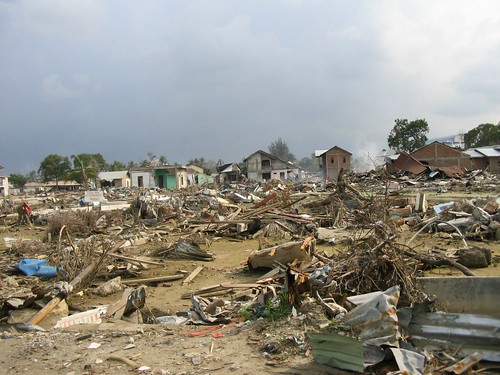
Tsunamis don’t just cause tremendous life loss, they can also cause massive physical damage. Tsunamis have been known to destroy entire builds and left towns to looking like a nuclear war zone! Boats in the water have been hurled viciously to shore clicking the people on the boat and smashed them to bits! The landscape and environment is also widely affected by a tsunami. The force of it can spread hazardous chemicals and waste products to spread to new areas, poisoning marine life. Coral Reefs can also be affected, because the abrupt appearance of such a large amount of seiment can smother the floral reefs, many beaches are left without sand, and flora and fauna (such as trees etc…) can be killed as well.
Tsunami Warning Systems:
When an unannounced/unknown tsunami is about to hit, it seems vital to have a way to warn people. By having a warning system people are able to prevent the destruction of buildings and the amount of life loss. There are two warning systems when it comes to tsunamis one is the Regional Warning System (RWS) and the other is the International Warning System (IWS.) The Regional Warning System uses the local data for seismic waves in order to decide when the tsunami is going to occur. The International Warning System takes seismic data from other countries in order to determine when and if a tsunami is going to occur. When the tsunami is detected a series of sirens or alarms go off warning people of the arriving tsunami.
Tsunami Safety and How to be Safe in a Tsunami: (Before)
1.Find out danger area
2.Know how high above sea level you are
3.Familizarize yourself with tsunami warning signs
4.Make sure you and your family members know how to respond properly to a tsunami
5.Know or make evacuation plans
6.Know how and when to turn of gas, electricity, and water
7.Have proper supplies at hand; flashlight and extra batteries, first aid kit, emergency food and water, essential medicines, cash and credit cards, sturdy shoes.
8.Develop emergency communication plan and have an emergency contact outside country.
During Tsunami:
1.Listen to radio and television for latest emergency information
2.If hear official tsunami warning or detect sign of a tsunami evacuate at once and climb to higher ground.
3.Stay away from beach
4.Stay out of area until advised to do otherwise by authorities (tsunamis are usually more than one wave.)
After a Tsunami:
1.Keep listening to latest emergency information.
2.Help injured or trapped people
3.If seriously injured person call for help do not try and move.
4.Stay away and out of damaged buildings.
5.When advised to return home do so immediately and enter with caution
6.Check food supply and test drinking water before drinking
7.Throw out food and water that could have been contaminated by flood water.
Over all I think that forecast sensors are the best way of detecting a tsunami however they don’t always work so knowing what to do and how to be safe in a tsunami is extremely important.
Bibliography/Works Sited:
Fuller,, Simon. "What Damages Do Tsunamis Cause? | EHow.com." EHow | How To Do Just About Everything! | How To Videos & Articles. 24 Nov. 2010. Web. 24 Feb. 2011. .