Saturday, 11 June 2011

Dropping Marbles in Flower: Crater Lab

Guiding Question: What are the factors that affect the appearance of impact craters? How do scientists use craters to tell the relative age of them?

Hypothesis: Speed, mass, velocity, vastness, ground texture.

Materials:
-Safety Goggles - Tray
- Flour - Notebook - Spoon
- Small and large marbles
- Ruler (cm)
- Excel and Word

Terms:
Floor:
Bowl shaped or flat,characteristically below surrounding ground level unless fulled in with lava.
Ejecta:
Blanket of material surrounding the crater that was excavate during the impact event. Ejecta become thinner away from the crater.
Raised Rim:
Rock thrown out of the crater and deposited as a ring-shaped pile of debris at the crater's edge during the explosion and excavation of an impact event.
Walls: Characteristically steep and may have giant stairs called terraces.
Rays: Bright streaks starting from a crater and extending away for great distances. See Copernicus crater for another example.
Central Uplifts:
Mountains formed beca
use of the huge increase and rapid decrease in pressure during the impact event. They occur only in the center of raters that are larger than 40 Km diameter. See Tycho crater for another example.

Part 1:

  1. Put on goggles and apron. Fill the pan with 2.5 cm of flour.
  2. Drop a small marble into the flour. What did you observe? Drop another marble again. What happens when they overlap? When you throw it next to one it creates a larger crater and indent.
  3. Think about guiding question. What does affect the appearance of an impact crater?
  4. Decide on which materials you will use and collect them all to take your station. You will make a model to test the guiding question.
  5. You will need to collect some qualitative (using senses to make observations) and quantitative - numerical data (height of drop, mass of the object, diameter of crater, depth of the crater, length of ejecta if possible to measure, etc...)
  6. Make a data table in your notebook.
  7. Run you lab according to the method provided.
Data Table:


Conclusion
One very strange thing that i noticed while making my observations was that the higher you dropped the marble from it would bounce out. This would create to craters, though the second crater was very small compared to the first it was still two craters that were created by just one marble! So in coclusion i think that what really changes the appearance of a crater is the distance, speed, weight, and angle.

Further Inquiry:
Some other things that i would like to try, is measuring how the size of the crater varies, and how using other materials as craters would make an impact. I think that this would be interesting because by changing the material as well as the size the weight/mass would be altered causing, maybe, craters with different appearances.

Thursday, 26 May 2011

Current Events: Carrying Humans Into Deep Space

NASA has now reached one of its most important milestones for the U.S. NASAs administrator Charles Bolden on May 25, 2011 announced that the system will be based on designs that originated in the plan for the Orion Crew Exploration Vehicle. The goal of this is to carry humans into deep space! And now these plans are being used to develop a new spacecraft called the Multi- Purpose Crew Vehicle the MPCV.
As Bolden says "We are committed to human exploration beyond low-Earth orbit and look forward to developing the next generation of systems to take us there. The NASA Authorization Act lays out a clear path forward for us by handing off transportation to the International Space Station to our private sector partners, so we can focus on deep space exploration. As we aggressively continue our work on heavy lift launch vehicle, we are moving forward with an existing contract to keep development of our new crew vehicle on track."
The space craft is being built so that it should be able to carry four astronauts on a 21-day missions and be able to land in the Pacific Ocean just off the California coast. It will have a pressurized volume of 690 cubic feet along with 316 cubic feet of habitabl
e space.


Wednesday, 25 May 2011

Eclipse's: All About Them


What causes an eclipse?
An eclipse is caused by the moon moving into direct alignment with the sun and EarthThere are two types of eclipses, a lunar eclipse (when the Earth is directly in between the sun and moon.) and a solar eclipse (when the moon passes between the sun and Earth.)

What causes tides how do they occur?
Tides are the rising and falling of the sea. This usually happens twin during
a lunar day at a particular time and place. This happens because of the gravitational interaction between the Earth and the Moon. This gravitational interaction causes the oc
eans to bulge out in the direction of the moon. Another bulge is also caused on the other side seeing as Earth is also being pulled towards the moon. Due to Earth being in constant rotation (as i said before) this causes tides to occur twice a day.

What is a lunar and solar eclipse?
A lunar eclipse is when the Earth passes directly inbetween the sun and moon. Whereas a solar eclipse happens when the moon passes directly inbetween the sun
and Earth.


Which type of eclipse is more common?
Some scientists have said that on a worldwide bases scale solar eclipses outnumber solar eclipses by about a 3 to 2 page margin.
When is the next eclipse occuring?
The next solar eclipse will occur on May 20th 2012.

What are the dangers of veiwing an eclipse?
You could possibly go blind due to the radiation from the sun. You are not meant to look at the sun in general but the awe of the eclipse causes you to relax.
What are the phases of the moon?
What causes the phases of the moon?
The phases of the moon are caused by the rotation of them and it is the shadow reflected from the sun.

Friday, 20 May 2011

Phases of the Moon

What did you notice about thephases of the moon?
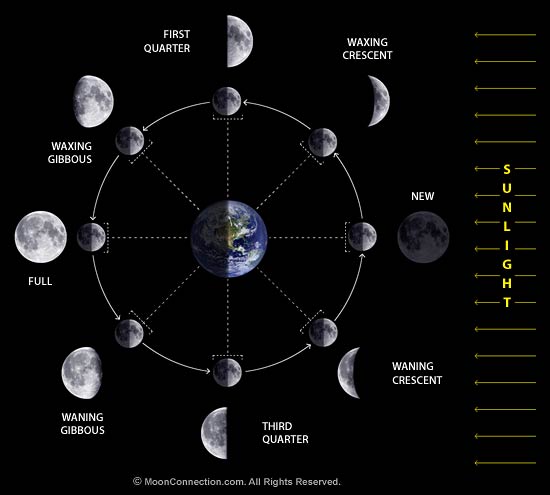
I noticed that the moon has four major cycles, the new moon, 1st quarter, full moon,
and last/3rd quarter. All of these phases have something to do with relative positions of the sun, moons, and the Earth during the moons 29.9 day orbit of Earth. I also learned that you can;t see the other side of the moon. isn't that amazing?! Also the moon reflects off of the sun therefore it doesn't produce its own light!
Why do we see different parts of the moon each night?Due to the position of the moon while revolvoing around Earth the p
osition of the moon in relation to the sun changes. So, depending on where the moon is we see different shapes on it, so the more light the moon receives from the sun the bigger the shapes will be on the moon (just like shadows.)
What is a lunar month?
A lunar month is the compete cycle of the moon revolving around our Earth. This is what we call a month, it takes around 29.9 days for a full cycle to be complete.


What causes an eclipse and tide? An eclipe is when the earth and moon go over each other/block each other from the sun. Tides are the rising and falling of ocean water. Tides are caused by how much of the moons gravity is pulling in the different poles of the Earth.


Tuesday, 10 May 2011

Reasons for the Seasons Lab

When it is winter in the Northern hemisphere which areas on Earth get the most concentrated light? Which areas get the most concentrated light when it is summer in the Northern Hemisphere?
During winter in the northern hemisphere it is summer in the southern hemisphe
re. The contenants that are part of the southern hemisphere is south america, southern Africa, Antartica, and Australia. So during winter in the Northern He
misphere it is summer in those countries. So areas that get the most consentrated light are the tropic of capricorn, tropic of cancer, and the equator.
Compare your observation of how hte light hits the area halfway between the equator and the North Pole during winter (step 6) and druing summer (step 9).
Sometimes the squares would look more like rectangles. The shadow on the toothpick will change according to where the earth is in its rotation around the sun.

If the squares projected on the ball from the acetate become larger, what can you infer about he amount of heat distributed in each square?
That there is more heat distribution and that it is probably closer to the sun .

According to your observations, which areas on Earth are consistently coolest? Which areas are consistently warmest? Why?
The Arctic and Antarctic and North and South Pole are the co
ldest places on earth due to the sun never fully stri
king these areas head on.

What time of year will the toothpick's shadow be longest? When will the shadow be shortest?
I think during summer it will be the longest and during winter it will be the shortest.

Use your observations of an Earth-sun model to write an explanation of what causes the seasons.
I think that the seasons are caused by the tilt of Earths axis away or toward the sun as it travels its year long (365 day) path around the sun.


Thursday, 28 April 2011

Waves All Around Us: Unit Reflection


Heres my brain storm on a brief summery of what i learned this unit:

How does the use and study of waves affect societal well-being?
During the first part of our unit on waves we learn't about how waves aren't just the waves that you swim in at the beach. They are all around us, so throughout this unit we learn''t the basics of waves and all about the different types of waves. This variety of waves
includes seismic waves, sounds waves, electromagnetic waves, surface waves,
We started with the most well known waves,
Water Waves: Water waves can effect our lives both positively and negatively, from a fun day to a beach to a drastic tsunami. Water waves are
known as seismic waves, seismic waves are formed from stress in the rock. When the rock moves from its original space it will send energy throughout Earth.
When two types of waves known has p and s waves (p = primary s = sec
ondary waves). When these two waves combine they create an earthquake and/or a tsunami. While studying these types of particular waves we learn't a lot about what to do if you are in a situation where there is a tsunami or earthquake.
Sound Waves:
We started of this section of our unit by leaning how sound travels and how it effects us. One of the most memorable parts of this unit for me was learning about how damaging and how many types of noise pollution there is!
Electromagnetic Waves:
While studying electromagnetic waves we lean't a lot about the electromagnetic spectrum. The electromagnetic spectrum includes; radio waves, microwaves, infrared waves, visible light waves, ultraviolet waves, x-rays, and gamma rays.
What did I like about this unit?
I liked this unit because it was slightly different from some of our previous units, like how we started simple and then branched out into wide variety of all the waves around us. I also liked all the projects that we did while working with different people than we're used to.
I think that for next years students the layout of the unit could stay the same and they could all still learn alot! but I think that a bit more on the electromagnetic spectrum could be nice because even though we had all the presentations on different parts of the spectrum i still find it a bit hazy.


Tuesday, 19 April 2011

Irradiated Foods

Will irradiating food make people less careful about handling the food?

I would say yes. Because though there should be no difference in the way people handle irradiated food vs non irradiated food, people will think that because the irradiated food is sterilized and almost all the bacteria is gone that they do not need to be as careful and hygenic in the way the handle the food. However, this is not true, irradiated food can still become contaminated. And the amount of radiation will not kill all the harmful and dangerous organisms in the food, it is still necessary to good it propery before you eat it (especially meat and eggs.)
So i think that when companies label irradiated foods they should also give warnings about th way that you still need to/should handle the food. Because, yes, people who understand what irradiated food is are probably more likely to be more careless while handling irradiated foods.
Pros and cons of irradiated food: Pros:
- Healthy way of sterilizing food.
- Can kill and reduce the number/amount of dangerous organisms in food (90-99%)
- Helps foods be stored longer/ last for longer thus decreasing famine and prices seeing as not as much food is needed to be bought.
- Works as an alternative to fumigation
Cons:

- Irradiation ca destroy up to 95% of the vitamins and minerals that are essential to our bodies
- Irradiation doesn't necessarily get rid of all the bad things in food.
- Some people don't always treat irradiated food with as much caution (while handling) as they should. (see paragraph above.)

Statement: I think that irradiation should not be encouraged but it shouldn't be banned. I think that it is working as a step to creating a technology that does similar things that everyone benefits from.